
Europe’s extreme summer heat has damaged crops just as conflict in the Middle East is pushing up energy and fertilizer costs, the war in Ukraine is again disrupting Black Sea grain exports, and a potentially very strong El Niño threatens to extend climate stress into the next agricultural season. The world is not (yet) running out of food, but its safety margins are getting thinner.
Europe: record heat moves from the thermometer to the field
Western Europe has just experienced its hottest June–July period on record, with an average temperature of 21.62°C — 2.79°C above the 1991–2020 average. France, Spain, Belgium, Switzerland, England and Wales were among the areas recording unprecedented June–July temperatures. In July alone, temperatures across France, Germany, northeastern Spain, England, Switzerland and western Italy were generally 3–5°C above normal.
The problem was not heat alone. It coincided with severe soil-moisture deficits. By mid-August, drought-alert conditions extended across France, Belgium, the Netherlands, southern Germany, northern Italy and much of the Danube basin.
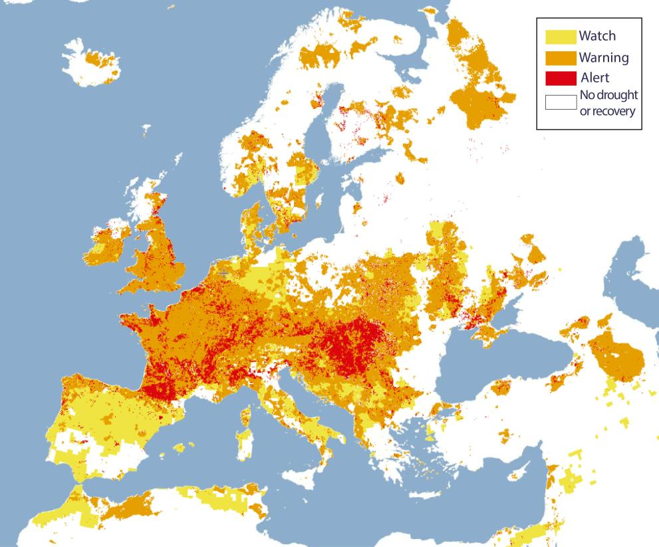
Drought in Europe – August 2026 – 2nd ten-day period
© EU, 2026. Licensed under CC BY 4.0. Source: EU Drought Observatory, Copernicus Emergency Management Service
The agricultural consequences are now becoming visible. The European Commission’s crop-monitoring service has cut its forecasts for EU summer crops, with expected yields now as much as 14% below the five-year average. Persistent heat and exceptional water deficits have caused impacts ranging from moderate losses to severe damage in western and central Europe.
That matters well beyond Europe. The same weather patterns are appearing across several major producing regions, increasing the risk that harvest shocks occur simultaneously rather than cancelling one another out.
Iran: no end in sight, and global costs are mounting
The conflict involving Iran has disrupted the Strait of Hormuz, one of the world’s most important corridors for energy and fertilizer. FAO warns that interruptions there are already raising agricultural input costs and could ultimately affect crop yields, particularly in countries dependent on imported fertilizer and energy.
The fertilizer shock has been particularly sharp. Urea prices climbed above $850 per tonne in April, around 80% higher than in February, as Middle Eastern exports were disrupted. The region normally accounts for close to one-quarter of global urea exports.
The World Bank now expects fertilizer prices to rise 31% in 2026, including an almost 60% increase in urea prices, pushing fertilizer affordability to its weakest level since 2022. It warns that if the conflict remains prolonged, higher food and energy costs could push up to 45 million additional people into acute food insecurity, according to a WFP scenario.
The danger is delayed as well as immediate. When fertilizer becomes unaffordable, farmers reduce application rates, plant less or switch crops. Today’s input-price shock pave the way to tomorrow’s yield shock.
Ukraine: another squeeze on the Black Sea
The war in Ukraine adds a third layer.
The Black Sea remains one of the world’s critical grain corridors. But renewed attacks on port and shipping infrastructure are again constraining exports from both Ukraine and Russia.
Ukraine has been forced to shift more grain toward the much more limited Danube route. By the end of August, around 80 vessels were waiting to access Ukrainian Danube ports, while the country’s main Black Sea ports, which had historically handled around 90% of its grain exports, remained heavily disrupted by Russian attacks.
Russia is also attempting to redirect grain exports toward Baltic routes after attacks disrupted its Black Sea and Sea of Azov infrastructure. But the alternatives have nowhere near the same capacity: about 46.3 million tonnes of Russian grain moved through Black Sea routes last season, compared with roughly 1 million tonnes through Russian Baltic ports.
The price signal is already visible. FAO’s Cereal Price Index rose 3.4% in July, while its overall Food Price Index reached 131.1 points, up 0.6% in a month, with weather, energy costs and geopolitical tensions among the main drivers.
And now El Niño
The final ingredient is climate.
El Niño is no longer simply a risk on the horizon. In August, NOAA confirmed that El Niño conditions had developed in the tropical Pacific and warned that the event was rapidly strengthening with a greater than 90% probability of becoming very strong during the Northern Hemisphere autumn and winter of 2026–27.
El Niño does not produce the same effect everywhere. It shifts atmospheric circulation and rainfall patterns, increasing drought risk in some regions and flooding in others. The WMO warned earlier this summer that developing El Niño conditions would increase the probability of extreme heat, abnormal rainfall, drought and floods across several regions.
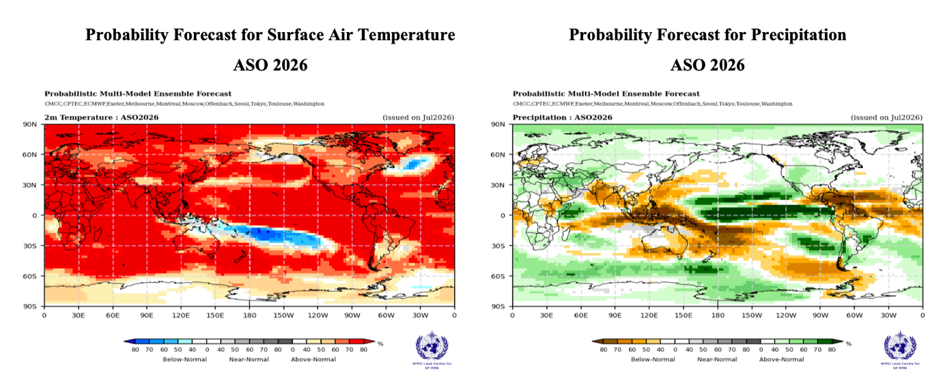
Probabilistic forecasts of surface air temperature and precipitation for the season August-October 2026. The tercile category with the highest forecast probability is indicated by shaded areas. The most likely category for below- normal, above-normal, and near-normal is depicted in blue, red, and grey shadings respectively for temperature, and orange, green and grey shadings respectively for precipitation. White areas indicate equal chances for all categories in both cases. The baseline period is 1993–2009. (Source: WMO Lead Centre for Seasonal Prediction)
WMO forecasts point to a rapid intensification of El Niño during the second half of 2026, with tropical Pacific temperatures expected to reach around 2.9°C above normal during August–October and peak in November. Forecast confidence is unusually high, with strong agreement between models.
The consequences are expected to be global. WMO projects above-normal temperatures across most major land areas, while rainfall patterns show the characteristic disruption associated with a strong El Niño. India, southern and eastern Australia, Central America, the Caribbean and northwestern South America face an increased risk of below-normal rainfall, while the Greater Horn of Africa, southeastern South America and parts of Central Asia are more likely to experience wetter conditions.
For food systems, the concern is therefore not simply higher temperatures, but the simultaneous emergence of drought risks in some major producing regions and excessive rainfall or flooding in others, at a time when agricultural markets are already under pressure from heat, conflict and high input costs.
That means another layer of uncertainty around major commodities including wheat, rice, maize, soybeans, sugar, coffee, cocoa and palm oil.
The consequences could extend well into 2027. El Niño often exerts its strongest influence on global temperatures during the year following its onset, and WMO scientists warn that the event developing at the end of 2026 increases the chances of 2027 becoming the next record-breaking year for global temperature.
For the global food system, this raises an uncomfortable prospect: the harvest shocks of 2026 may not be followed by a return to normal conditions, but by another season of climate volatility, just as farmers, governments and food-importing countries are trying to rebuild their buffers.
Adaptation can no longer wait
The world is entering a period in which climate shocks, geopolitical instability and economic fragmentation increasingly reinforce one another. Retreating from climate action now would be a costly mistake.
Adaptation must become a strategic priority: protecting food systems, financing resilient agriculture, and ensuring that the transition does not leave the most vulnerable countries and farmers to carry the heaviest burden. That requires stronger solidarity mechanisms, more accessible climate finance and sustained international cooperation, precisely when political conditions make them harder to achieve.
The political challenge is simple: either we build the financial and solidarity mechanisms needed to deliver a just transition and accelerate adaptation, or the costs of inaction will resurface later through skyrocketing food prices, greater instability and worsening humanitarian crises.